Meet Emma, the First Nuplex Persona
Meet Emma, the First Nuplex Persona
Nuance Labs
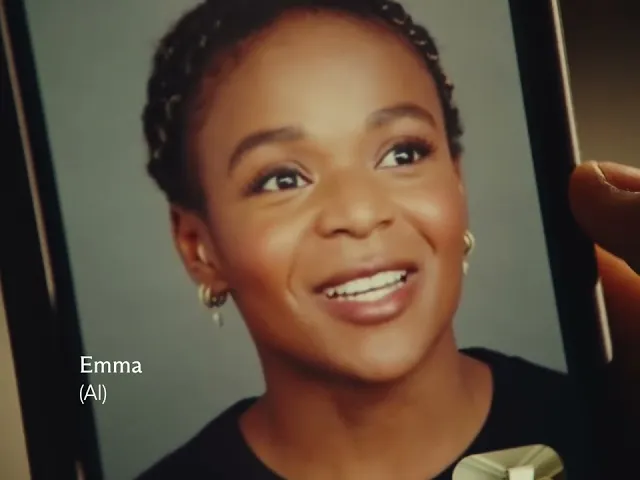
After 18 months of research, we crafted Emma, an AI persona you'll actually want to meet face-to-face. She's built on Nuplex 1.0, our full-duplex audiovisual foundation model.
Meet her today at emma.nuancelabs.ai, or build with our Nuplex Beta API at platform.nuancelabs.ai.
What makes Emma different
Conversation that flows face to face
Emma talks to you with her face, not just her voice.
No existing benchmark properly measures the naturalness of a face-to-face interaction, so we measured Emma against how real people talk to each other.
Here are some examples of things we paid attention to during our development.
Reply latency is the number everyone measures, and on its own it doesn't settle much. The full-duplex systems in the chart below spread out along it. Open models like PersonaPlex and Moshi are tuned to answer fast and max out the existing benchmarks. Product offerings like GPT-Live and Gemini Live take longer, most likely because they would rather not cut you off. Nuplex sits between them. Faster or slower is a product decision, not a score, so we asked a different question: when does a person reply? On 1,785 questions from our own recordings of real conversations, Nuplex's reply timing overlaps the original speaker's 89% of the time. The next closest system is at 35%.

Reply latency is the number everyone measures, and on its own it doesn't settle much. The full-duplex systems in the chart below spread out along it. Open models like PersonaPlex and Moshi are tuned to answer fast and max out the existing benchmarks. Product offerings like GPT-Live and Gemini Live take longer, most likely because they would rather not cut you off. Nuplex sits between them. Faster or slower is a product decision, not a score, so we asked a different question: when does a person reply? On 1,785 questions from our own recordings of real conversations, Nuplex's reply timing overlaps the original speaker's 89% of the time. The next closest system is at 35%.
These metrics show that Emma's conversational flow uses her visual cues, which makes her different from previous offerings in this space. However, we believe benchmarks in the AV full-duplex space are not accurate to the user experience yet.
You don’t have to take our word for it. Simply meet Emma.
A face and a personality that feel like someone.
A lot of work on Emma is frontier ML: more data, more compute, and the runtime infrastructure to run her in real time. But Emma isn't just an ML model. What makes Emma different also comes from a different kind of work, closer to psychology and linguistics, and design and performance than to ML. It’s a collaboration between our researchers, our creative team, and the real people whose likenesses and voices contribute to our personas. The small things have to be noticed, crafted with purpose, designed into her and post-trained.
Natural Emotions
Ask professional actors to portray the same emotion and you get wide variation (Le Mau et al. 2021). AI-generated faces produce a prototypical expression instead: easier to label and more intense than real posed photographs (Kramer et al. 2026). Average many people and you get something muted. Optimize for a label and you get a cartoon. Neither looks like anyone.
Emma's voice and face come from a real actress, who collaborated with us to capture moments of how she actually listens, reacts and speaks. Emma's emotions and mannerisms are designed to reflect a specific character’s, rather than an average or generalization of training data. You’ll see the difference when comparing real-time AI-generated faces (left) and Emma (right).
Emma is full of small mannerisms that are hers: a long blink for emphasis, a squint, eyes that wander and come back, a little jump when she can't hold back how strongly she feels, and a head that moves with what she's saying.

Beyond her likeness and voice, Emma has a deliberately crafted personality. She is curious and quick-witted, has opinions and will disagree with you, while being upfront that she's an AI. Most AI is agreeable to a fault: it repeats what you said, praises it, draws a tidy moral, and ends on a question, because the preference data these models are trained on reward answers that agree with the person asking (Sharma et al. 2024). Emma is different while still being uniquely consistent: one face, one voice, one temperament.
You can’t zero-shot a compelling character from a single photo. It’s the intentional design, consistency, and unique nuances that make it feel like you're talking to someone, not just anyone.
How we keep it safe
Technology this expressive needs limits. The first people who talked to Emma told us two things, often in the same breath: it was amazing, and it was a little unsettling. We take both seriously. What we don't build matters as much as what we do, so we're rolling Nuplex out carefully.
As a starting point, both Emma and the Nuplex Beta API are intentionally limited (even annoyingly so):
You'll always know you're talking to an AI. Emma never claims to be human, and neither do our other personas. We refuse developer prompts that try to make one, or that pose it as a real company or person, and video served through the API carries a visible watermark.
No cloning. The Nuplex Beta API can't clone real people, and our team won't without your clear permission. You can't upload a face or a voice, and a custom face we build can only be used by the organization it was made for.
No sexually explicit content, and no AI girlfriends or boyfriends.
Some areas stay closed for now. Healthcare and anything involving under 18s, including education, need even higher standards, so they aren't in the beta. Building toward those standards? Reach out at enterprise@nuancelabs.ai.
Tested before launch. We tested Emma against published benchmarks for sycophancy, manipulation and emotional reliance.
How we hold the line. Every developer prompt is screened before a conversation starts. During the call, automated checks end it if a user expresses intent toward serious violence, uses slurs or hate speech, raises sexual content, or shows weapons or gore on camera. A persona's own words are checked too: if it ever asks for a passcode, card details, money, or remote access to a device, the call ends. Someone who seems to be in crisis gets pointed to help, like the Suicide & Crisis Lifeline, not a hang-up. Repeated violations pause new conversations. Emma and the Nuplex Beta API are for adults (18+) only. All use is governed by our Terms of Service and Acceptable Use Policy.
These checks will miss things, and they'll sometimes end calls that were fine. Tell us about either at safety@nuancelabs.ai.
What Emma can't do yet
Emma is a real step toward natural conversation, but she still falls short of how people talk to each other.
She can make mistakes. Emma’s reasoning comes from a language model, so she can make confident mistakes. She might still miscount the e’s in “seventeen” or the r’s in “strawberry.”
Conversation dynamics are hard. She can jump in while you're still mid-thought, wait a beat too long, or miss a cue a person would catch. Long pauses mid-sentence are the hardest case.
English only, for now.
Noise gets in the way. Background voices, a TV, speakerphone, or a weak mic make turn-taking worse. Headphones certainly help.
Streaming visual understanding is still early. With your camera on, Emma can talk about what she sees, but she can sometimes miss details and misread scenes.
Visual glitches. Lip sync, gaze, and head motion occasionally look off, especially on a poor connection, and her expression can slip back to neutral mid-conversation.
She can’t sing :)
Build with Nuplex Beta API
We're also releasing the Nuplex Beta API, with a few different personas. Brief a persona with your own prompt, follow the conversation as it happens, and let it hand longer tasks to your tools in the background while it keeps talking with your user. It's intentionally limited for now, and more personas and use cases are coming quickly. Start at platform.nuancelabs.ai.
For enterprises, we also build custom personas by arrangement, only with explicit permission from anyone whose face or voice is used. enterprise@nuancelabs.ai
FAQ
What does "Nuplex" stand for? Nuance Full-duplex: a real-time machine learning system that listens and speaks simultaneously.
Is Emma a real person? No, Emma is an AI. Her face and voice are licensed from an amazing actress we have the pleasure of working with.
Do I need an account to talk to Emma? No.
Where are Emma and the Nuplex Beta API available? The United States except Colorado, Connecticut, Illinois and Texas; the EU; the UK; and Canada except Quebec.
Can I use my own language model? Nuplex works with any language model, but in the beta we serve one ourselves. In the beta, you can adjust the persona with your prompt, and your tools can call any model or service you like.
Can I use my own voice or face? This is not self-serve. Custom faces are available by arrangement, only with explicit permission from the person whose face it is.
References
We're grateful to the researchers whose work shaped how we think about conversation.
Kramer, R. S. S., Javorková, N., & Clark, P. R. (2026). AI-generated face images of emotional expressions. Journal of Nonverbal Behavior, 50(3), 379–395.
Le Mau, T., Hoemann, K., Lyons, S. H., Fugate, J. M. B., Brown, E. N., Gendron, M., & Barrett, L. F. (2021). Professional actors demonstrate variability, not stereotypical expressions, when portraying emotional states in photographs. Nature Communications, 12, 5037.
Poppe, R., Truong, K. P., & Heylen, D. (2011). Backchannels: Quantity, type and timing matters. In Intelligent Virtual Agents (IVA 2011), Lecture Notes in Computer Science, 228–239. Springer.
Reece, A., Cooney, G., Bull, P., Chung, C., Dawson, B., Fitzpatrick, C., Glazer, T., Knox, D., Liebscher, A., & Marin, S. (2023). The CANDOR corpus: Insights from a large multimodal dataset of naturalistic conversation. Science Advances, 9(13), eadf3197.
Sharma, M., Tong, M., Korbak, T., Duvenaud, D., et al. (2024). Towards understanding sycophancy in language models. International Conference on Learning Representations (ICLR 2024).
The comparison clips in the emotion panels were made with the publicly available products of Tavus, LemonSlice and Keyframe Labs, teams working on the same hard problem from different angles.
Citation
Please cite this work as:
Nuance Labs, "Meet Emma, the First Nuplex Persona", Nuance Labs, November 2026.
Or use the BibTeX citation:
BibTeX
@article{nuancelabs2026nuplex,
  author = {Nuance Labs},
  title = {Meet Emma, the First Nuplex Persona},
  journal = {Nuance Labs},
  year = {2026},
  month = {November},
  note = {http://research.nuancelabs.ai/},
}After 18 months of research, we crafted Emma, an AI persona you'll actually want to meet face-to-face. She's built on Nuplex 1.0, our full-duplex audiovisual foundation model.
Meet her today at emma.nuancelabs.ai, or build with our Nuplex Beta API at platform.nuancelabs.ai.
What makes Emma different
Conversation that flows face to face
Emma talks to you with her face, not just her voice.
No existing benchmark properly measures the naturalness of a face-to-face interaction, so we measured Emma against how real people talk to each other.
Here are some examples of things we paid attention to during our development.
Reply latency is the number everyone measures, and on its own it doesn't settle much. The full-duplex systems in the chart below spread out along it. Open models like PersonaPlex and Moshi are tuned to answer fast and max out the existing benchmarks. Product offerings like GPT-Live and Gemini Live take longer, most likely because they would rather not cut you off. Nuplex sits between them. Faster or slower is a product decision, not a score, so we asked a different question: when does a person reply? On 1,785 questions from our own recordings of real conversations, Nuplex's reply timing overlaps the original speaker's 89% of the time. The next closest system is at 35%.
These metrics show that Emma's conversational flow uses her visual cues, which makes her different from previous offerings in this space. However, we believe benchmarks in the AV full-duplex space are not accurate to the user experience yet.
You don’t have to take our word for it. Simply meet Emma.
A face and a personality that feel like someone.
A lot of work on Emma is frontier ML: more data, more compute, and the runtime infrastructure to run her in real time. But Emma isn't just an ML model. What makes Emma different also comes from a different kind of work, closer to psychology and linguistics, and design and performance than to ML. It’s a collaboration between our researchers, our creative team, and the real people whose likenesses and voices contribute to our personas. The small things have to be noticed, crafted with purpose, designed into her and post-trained.
Natural Emotions
Ask professional actors to portray the same emotion and you get wide variation (Le Mau et al. 2021). AI-generated faces produce a prototypical expression instead: easier to label and more intense than real posed photographs (Kramer et al. 2026). Average many people and you get something muted. Optimize for a label and you get a cartoon. Neither looks like anyone.
Emma's voice and face come from a real actress, who collaborated with us to capture moments of how she actually listens, reacts and speaks. Emma's emotions and mannerisms are designed to reflect a specific character’s, rather than an average or generalization of training data. You’ll see the difference when comparing real-time AI-generated faces (left) and Emma (right).
Emma is full of small mannerisms that are hers: a long blink for emphasis, a squint, eyes that wander and come back, a little jump when she can't hold back how strongly she feels, and a head that moves with what she's saying.
Beyond her likeness and voice, Emma has a deliberately crafted personality. She is curious and quick-witted, has opinions and will disagree with you, while being upfront that she's an AI. Most AI is agreeable to a fault: it repeats what you said, praises it, draws a tidy moral, and ends on a question, because the preference data these models are trained on reward answers that agree with the person asking (Sharma et al. 2024). Emma is different while still being uniquely consistent: one face, one voice, one temperament.
You can’t zero-shot a compelling character from a single photo. It’s the intentional design, consistency, and unique nuances that make it feel like you're talking to someone, not just anyone.
How we keep it safe
Technology this expressive needs limits. The first people who talked to Emma told us two things, often in the same breath: it was amazing, and it was a little unsettling. We take both seriously. What we don't build matters as much as what we do, so we're rolling Nuplex out carefully.
As a starting point, both Emma and the Nuplex Beta API are intentionally limited (even annoyingly so):
You'll always know you're talking to an AI. Emma never claims to be human, and neither do our other personas. We refuse developer prompts that try to make one, or that pose it as a real company or person, and video served through the API carries a visible watermark.
No cloning. The Nuplex Beta API can't clone real people, and our team won't without your clear permission. You can't upload a face or a voice, and a custom face we build can only be used by the organization it was made for.
No sexually explicit content, and no AI girlfriends or boyfriends.
Some areas stay closed for now. Healthcare and anything involving under 18s, including education, need even higher standards, so they aren't in the beta. Building toward those standards? Reach out at enterprise@nuancelabs.ai.
Tested before launch. We tested Emma against published benchmarks for sycophancy, manipulation and emotional reliance.
How we hold the line. Every developer prompt is screened before a conversation starts. During the call, automated checks end it if a user expresses intent toward serious violence, uses slurs or hate speech, raises sexual content, or shows weapons or gore on camera. A persona's own words are checked too: if it ever asks for a passcode, card details, money, or remote access to a device, the call ends. Someone who seems to be in crisis gets pointed to help, like the Suicide & Crisis Lifeline, not a hang-up. Repeated violations pause new conversations. Emma and the Nuplex Beta API are for adults (18+) only. All use is governed by our Terms of Service and Acceptable Use Policy.
These checks will miss things, and they'll sometimes end calls that were fine. Tell us about either at safety@nuancelabs.ai.
What Emma can't do yet
Emma is a real step toward natural conversation, but she still falls short of how people talk to each other.
She can make mistakes. Emma’s reasoning comes from a language model, so she can make confident mistakes. She might still miscount the e’s in “seventeen” or the r’s in “strawberry.”
Conversation dynamics are hard. She can jump in while you're still mid-thought, wait a beat too long, or miss a cue a person would catch. Long pauses mid-sentence are the hardest case.
English only, for now.
Noise gets in the way. Background voices, a TV, speakerphone, or a weak mic make turn-taking worse. Headphones certainly help.
Streaming visual understanding is still early. With your camera on, Emma can talk about what she sees, but she can sometimes miss details and misread scenes.
Visual glitches. Lip sync, gaze, and head motion occasionally look off, especially on a poor connection, and her expression can slip back to neutral mid-conversation.
She can’t sing :)
Build with Nuplex Beta API
We're also releasing the Nuplex Beta API, with a few different personas. Brief a persona with your own prompt, follow the conversation as it happens, and let it hand longer tasks to your tools in the background while it keeps talking with your user. It's intentionally limited for now, and more personas and use cases are coming quickly. Start at platform.nuancelabs.ai.
For enterprises, we also build custom personas by arrangement, only with explicit permission from anyone whose face or voice is used. enterprise@nuancelabs.ai
FAQ
What does "Nuplex" stand for? Nuance Full-duplex: a real-time machine learning system that listens and speaks simultaneously.
Is Emma a real person? No, Emma is an AI. Her face and voice are licensed from an amazing actress we have the pleasure of working with.
Do I need an account to talk to Emma? No.
Where are Emma and the Nuplex Beta API available? The United States except Colorado, Connecticut, Illinois and Texas; the EU; the UK; and Canada except Quebec.
Can I use my own language model? Nuplex works with any language model, but in the beta we serve one ourselves. In the beta, you can adjust the persona with your prompt, and your tools can call any model or service you like.
Can I use my own voice or face? This is not self-serve. Custom faces are available by arrangement, only with explicit permission from the person whose face it is.
References
We're grateful to the researchers whose work shaped how we think about conversation.
Kramer, R. S. S., Javorková, N., & Clark, P. R. (2026). AI-generated face images of emotional expressions. Journal of Nonverbal Behavior, 50(3), 379–395.
Le Mau, T., Hoemann, K., Lyons, S. H., Fugate, J. M. B., Brown, E. N., Gendron, M., & Barrett, L. F. (2021). Professional actors demonstrate variability, not stereotypical expressions, when portraying emotional states in photographs. Nature Communications, 12, 5037.
Poppe, R., Truong, K. P., & Heylen, D. (2011). Backchannels: Quantity, type and timing matters. In Intelligent Virtual Agents (IVA 2011), Lecture Notes in Computer Science, 228–239. Springer.
Reece, A., Cooney, G., Bull, P., Chung, C., Dawson, B., Fitzpatrick, C., Glazer, T., Knox, D., Liebscher, A., & Marin, S. (2023). The CANDOR corpus: Insights from a large multimodal dataset of naturalistic conversation. Science Advances, 9(13), eadf3197.
Sharma, M., Tong, M., Korbak, T., Duvenaud, D., et al. (2024). Towards understanding sycophancy in language models. International Conference on Learning Representations (ICLR 2024).
The comparison clips in the emotion panels were made with the publicly available products of Tavus, LemonSlice and Keyframe Labs, teams working on the same hard problem from different angles.
Citation
Please cite this work as:
Nuance Labs, "Meet Emma, the First Nuplex Persona", Nuance Labs, November 2026.
Or use the BibTeX citation:
BibTeX
@article{nuancelabs2026nuplex,
  author = {Nuance Labs},
  title = {Meet Emma, the First Nuplex Persona},
  journal = {Nuance Labs},
  year = {2026},
  month = {November},
  note = {http://research.nuancelabs.ai/},
}